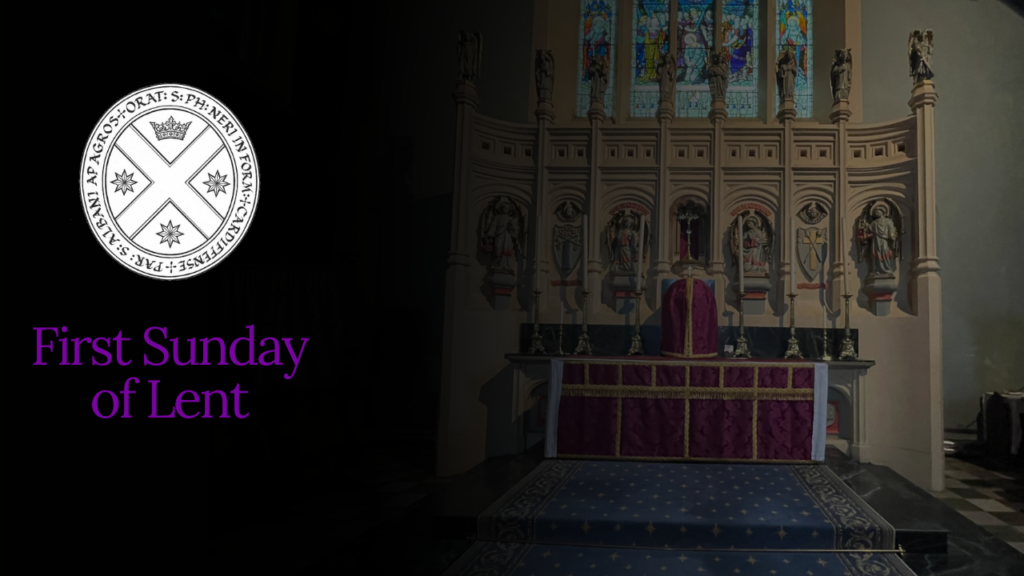
Today the Church invites us to enter once more into the sacred season of Lent, a time of grace, renewal, and return to the Lord. Each year, this holy season calls us into the desert with Christ, where hearts are purified, where we can overcome temptations, where we spend that time practicing the virtues God has given us. At the centre of this journey stands the ancient and powerful practice of fasting. From the early Church, Christians fasted in imitation of Christ in preparation for Easter. It was quite severe in the medieval period, but, one can be quite thankful for this, the practice has become a bit tame in the modern period. It is not that we have become weak as a people, but the development of understanding what fasting means.
Take St Thomas Aquinas, he states that fasting is virtuous for three reasons. 1Firstly it tempers our desires. That when we abstain from meat and drink we are no longer tempted to do certain things, because we either do not feel the need to do them, or we are distracted from them by our hunger. Secondly, that mind is easier to contemplate on higher things without thinking about material needs. He uses the example of Daniel fasting for three weeks when he had a revelation from God.2 We need not worry about what to eat so we can think of something else, namely God, instead. The third reason is that it makes satisfaction for sins. We heard the scriptural evidence for this on Ash Wednesday when the prophet Joel said, “be converted to me with all your heart, in fasting, weeping and mourning.”3 Through the act of fasting we are mortifying ourselves, not because we want to do it, but because the Church says it is a holy and good practice. As Fasting does all this, then clearly it can be seen as something virtuous to do.
Therefore, Pope Leo in his Lenten address highlighted the importance of this pillar of lent. He said, “fasting makes it easier to recognize what we “hunger” for and what we deem necessary for our sustenance”.4 What is it that we hunger for? Our relationship with God. For Easter is that great solemnity where we see the greatest love anyone has ever shown. We yearn to see the stone rolled away on Easter morning, that moment when Christ conquered the grave and made satisfaction for our sins. That desire is why we fast, that we can not be distracted by sin which breaks our relationship with God, that we can have our sins blotted out, and that we can think on how great the Father’s love is for us.” Understood in this way, fasting not only permits us to govern our desire, purifying it and making it freer, but also to expand it, so that it is directed towards God and doing good.”5
Therefore, as we continue this Lenten journey, let us not see fasting as an obligation, nor as a relic of a harsher age, but as a gift. The wisdom of Thomas Aquinas reminds us that fasting disciplines the body, elevates the mind, and makes satisfaction for sin. The words of Pope Leo XVI call us to recognise our deepest hunger: not for food, but for God. If we fast well, our desires are not diminished but purified; not crushed, but redirected. In hungering, we learn what truly sustains us. And so we fast in hope, that when Easter dawns, our hearts may be freer, our love deeper, and our joy greater in the Risen Lord.
- ST II-II, Q147 ↩︎
- Daniel 10:3 ↩︎
- Joel 2:12 ↩︎
- Pope Leo XIV. (2026). Message of the Holy Father Leo XIV for Lent 2026, 13.02.2026. [Online]. Holy See Press Office. Last Updated: 5th Februrary. Available at: https://press.vatican.va/content/salastampa/en/bollettino/pubblico/2026/02/13/260213d.html ↩︎
- Ibid ↩︎